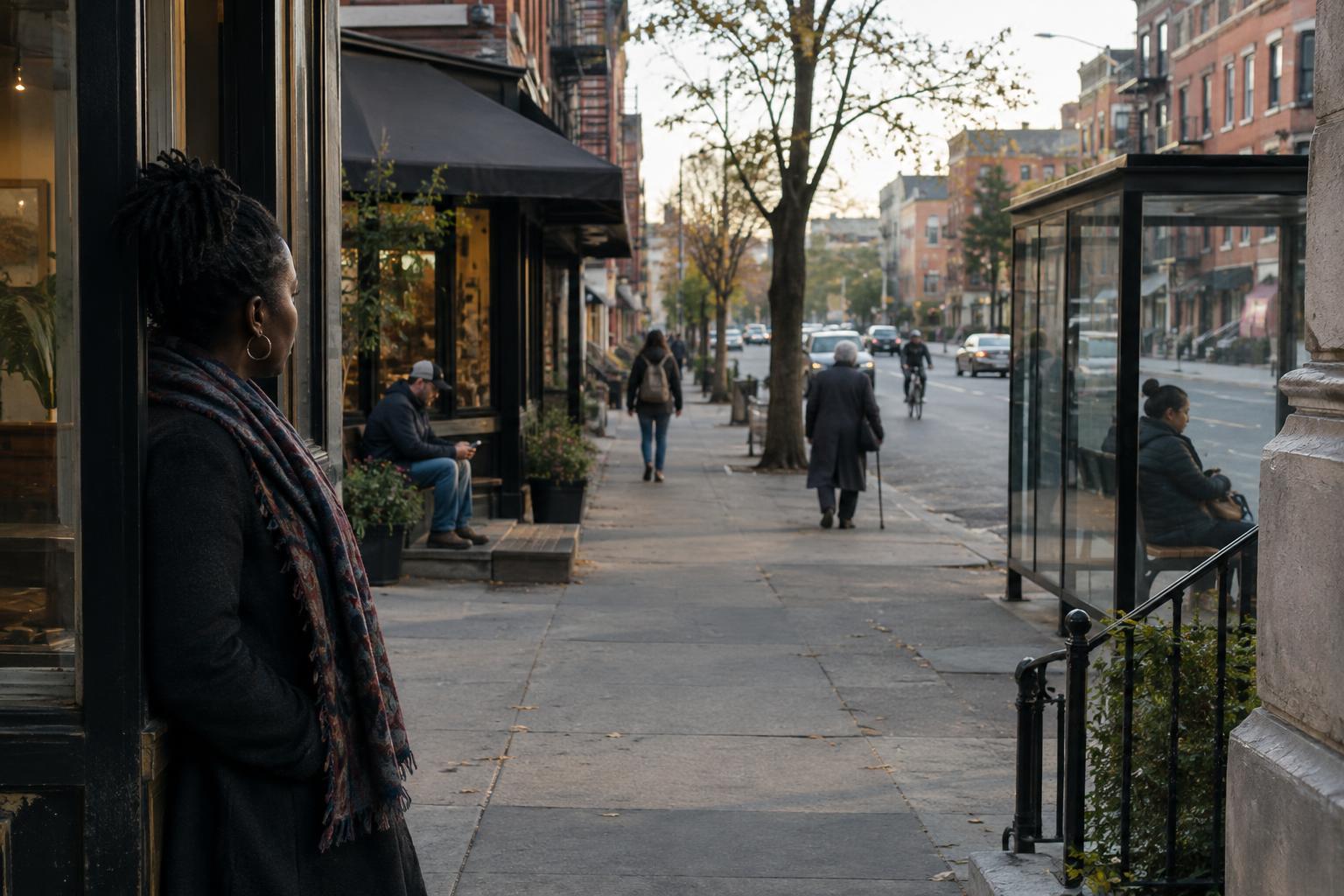
A city story is never the whole city
A story can cross a city in a single afternoon and still occupy a narrow world. Its narrator may know the streets around an apartment, a favorite café and the quickest route to work, but little about the people who keep those places running. That narrowness is not necessarily a flaw. A convincing point of view has limits. The question is whether the story recognizes those limits or lets one person’s experience stand in for everyone else’s.
This distinction matters in fiction, memoir and criticism alike. A writer may describe a neighborhood as newly lively because new businesses have opened, while overlooking the people who already found community there. Another may call a street empty after dark because its shops are closed, though residents are returning from shifts or gathering indoors. Such descriptions tell us something useful about the observer. They become less reliable when presented as complete descriptions of the place.
Notice who becomes part of the scenery
One way to find a missing perspective is to look at the people a story needs but seldom hears. Who cleans the station, delivers the food, repairs the lift or answers the door? Who has to travel across town for work, and who can afford to treat a short walk as the measure of a good neighborhood? These questions are not a demand that every minor character receive a biography. They reveal the assumptions behind a setting that seems to function on its own.
Pay attention, too, to the difference between being visible and having a perspective. A street vendor might appear in a scene only to provide color or a snack for the narrator. A group of teenagers might signal danger or energy without being allowed any particular purpose. When people serve mainly as atmosphere, readers learn more about the narrator’s expectations than about the people observed. That may be intentional, but it is worth noticing.
Ask whose memory gives the place its meaning
City stories often move through layers of time. A building is not just old or new; it may be a former workplace, a childhood landmark, a gathering place or a reminder of loss. The same corner can hold different meanings for a recent arrival, a lifelong resident and someone who visits only for work. No single account can settle those meanings. A richer story makes room for the possibility that its narrator’s memory is one among others.
Names offer a useful clue. Who names a district, a park or a stretch of shops in the story, and who uses another name? A label that seems natural to one speaker may be unfamiliar or unwelcome to someone else. Writers need not pause to explain every disagreement. A small moment of uncertainty—a character using a different name, or a narrator realizing they do not know a site’s earlier use—can show how memory and belonging shape what people think they see.
Read the boundaries of access
Perspective is shaped not only by identity but by access. A character’s account of a city depends on where they can go, when they can travel and whether they feel welcome or safe. Stairs, fares, opening hours, policing and private doors can make two people’s routes through the same area look entirely different. A story that lingers on effortless movement may be telling us as much about its narrator’s circumstances as about the city’s design.
This is also a question of form. Whose dialogue is quoted, and whose words are summarized? Which rooms can the narrator enter? Does a broad claim about a neighborhood rest on a brief visit? Asking these questions does not require a writer to speak on behalf of someone whose life they do not know. Sometimes the more honest choice is to keep the boundary visible rather than fill it with an invented certainty.
Make the question part of the writing practice
For a draft set in a city, try listing everyone who affects the action but never speaks. Then mark the places the central character knows well and those they only pass through. Look for sweeping phrases such as “everyone,” “no one” and “the neighborhood.” Could a more precise phrase preserve the force of the sentence while making clear who is doing the observing? Revision may call for a new scene, but it may simply call for a narrower claim.
The goal is not to build a story in which every possible perspective receives equal space. That would flatten differences of voice and turn characters into representatives. The goal is to make choices with care: to know whose story is being told, what that person cannot know and how other lives press against the edges of the frame. A city becomes more compelling on the page when those edges remain visible.