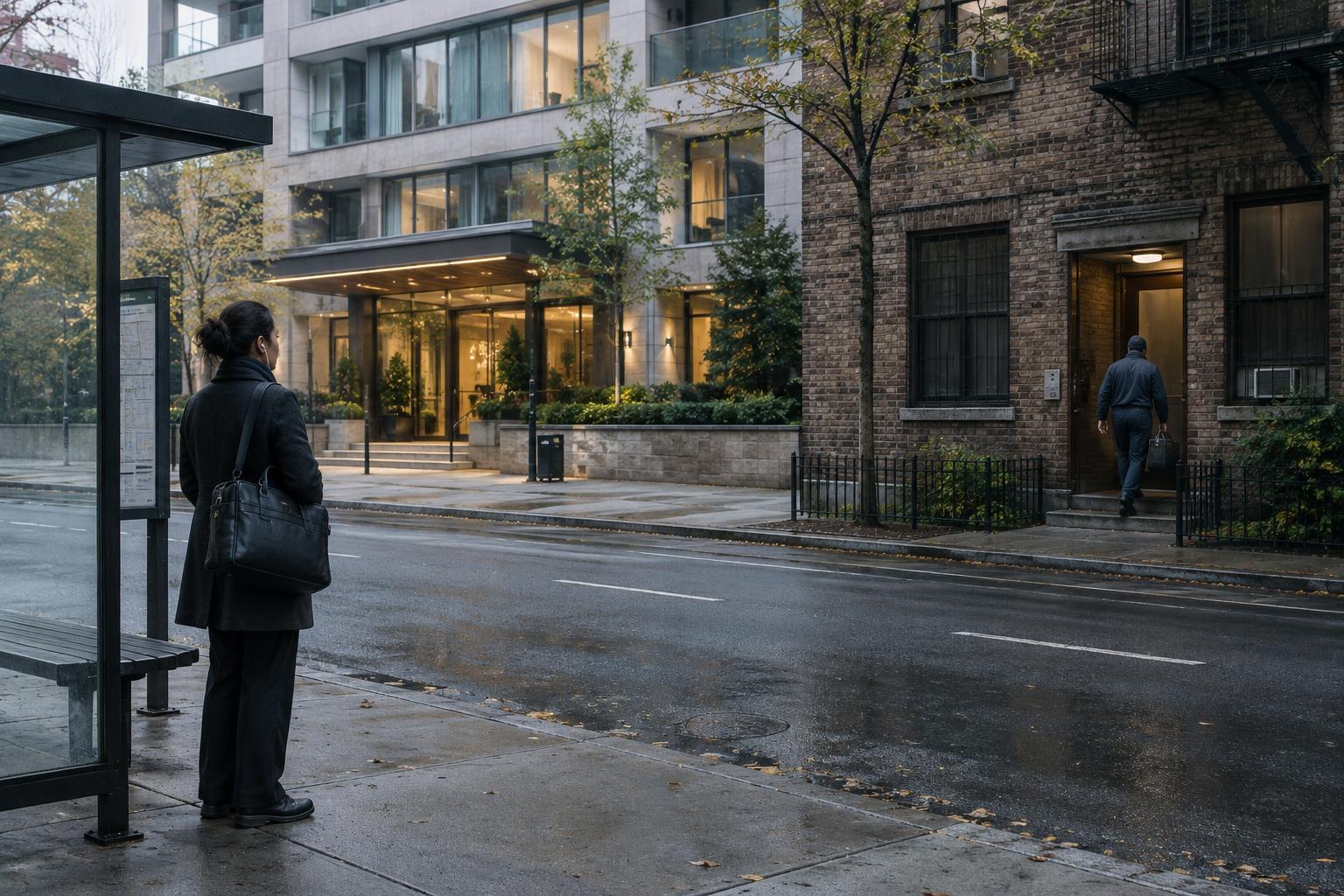
The city is not the same place for everyone
A screen city may be introduced with a skyline, but its characters rarely experience that skyline in the same way. One person sees a neighborhood from an apartment window; another passes through it on the way to work. One can linger in a café, while another has to account for the price of a drink or the time spent away from a shift. Class takes shape through these differences in access, comfort and control over time.
To notice class in an urban story, look beyond dialogue about money. Pay attention to where characters are allowed to go, how long they can stay and whether they can shut a door behind them. A home can be a place of rest, an overcrowded space requiring constant negotiation, or a property treated chiefly as an investment. The same street can offer freedom to one character and expose another to scrutiny. Space becomes part of the story when those experiences affect what a character can do next.
Homes, views and the promise of privacy
Interiors often make a character’s class position legible before anyone explains it. Room size, shared walls, storage, light and the distance between a bed and a kitchen can suggest how much privacy is available. Yet a polished apartment does not automatically mean security, just as a crowded room does not tell us everything about the people who live there. A careful reading asks what the setting enables: Can someone invite a friend over without negotiating with housemates? Can they make noise, leave possessions in place or expect to return next month?
The camera can reinforce or complicate those questions. A wide view of a desirable neighborhood may invite the audience to admire it as scenery. A closer view of a tenant packing, a worker cleaning or a family sharing a room brings the daily work of occupying that space into focus. Neither shot is inherently more truthful. Their meaning depends on what the story includes afterward—and whether residents remain people with lives beyond the visual appeal of their surroundings.
Movement reveals unequal choices
Urban stories often use movement to create energy: trains arriving, traffic flowing, pedestrians crossing a square. Class can be found in the terms of that movement. Who can choose a route, and who must take the route that fits a fare, schedule or job? A short journey shown as effortless for one character may require transfers, waiting and careful timing for another. When a film skips over commuting, it may also skip over an important part of how a character’s day is organized.
The ability to stop matters as much as the ability to travel. A character with time and money can browse, sit down or change plans. Someone working in the same district may encounter it mainly through entrances, service corridors and deadlines. Watching for these contrasts helps distinguish a city portrayed as a field of possibilities from one portrayed as a set of obligations. Both may be present in the same scene.
Who is seen, and whose work disappears?
Restaurants, shops, offices and apartment buildings can appear to run smoothly when the people who maintain them stay at the edge of the frame. Sometimes that is a deliberate choice, showing how certain characters fail to notice the labor around them. At other times, a story simply treats workers as part of the setting. One useful question is whether a worker has a perspective of their own or exists only to make another character’s experience possible.
This question also applies to depictions of neighborhoods described as changing. A screen story might emphasize new storefronts and renovated interiors while offering little sense of who used those spaces before, who keeps them operating or who can still afford to remain. Criticism need not assume that every film must tell every story. It can, however, identify the boundaries of a chosen viewpoint and ask what those boundaries encourage an audience to overlook.
A practical way to watch
When reading an urban film or series, choose one recurring location and track how different characters use it. Note who enters without explanation, who needs permission, who works there and who gets to leave. Then look at the filmmaking: Is the space shown in a sweeping shot or at the scale of a person’s daily tasks? Does sound make it feel calm, crowded, inviting or tense? These details may reveal more than an explicit statement about wealth.
Finally, resist reducing every character to a class symbol. People build attachments to places under unequal conditions, and a neighborhood can hold pleasure, frustration and memory at once. The strongest class-conscious reading keeps those feelings in view while asking a concrete question: whose version of city life has the story made easy to see, and whose has it left just outside the frame?