The useful shortcut and its cost
A city enters a story quickly. A glimpse of a skyline, a crowded train or a street at night can establish scale and mood before anyone speaks. Such details are useful: stories have limited time, and audiences bring associations of their own. The trouble begins when those associations do all the work. A city becomes a stereotype when its familiar image stands in for the varied lives, places and tensions that might complicate it.
That does not mean every story needs to show an entire metropolis. No single novel or film could. A romance may need only a handful of streets; a mystery may stay within one building. The question is whether the setting has a life beyond the role assigned to it. If the city exists only to make a character seem sophisticated, endangered, lonely or newly free, it may be functioning less as a place than as a label.
Watch what the camera or narrator leaves out
Stereotypes often emerge through selection rather than outright falsehood. A story can depict real features of urban life and still suggest that they define everyone who lives there. Repeated images of crowded sidewalks might make a city seem anonymous, while repeated images of rooftop views might make it seem effortlessly glamorous. Neither image is necessarily wrong; each becomes limiting when nothing interrupts it.
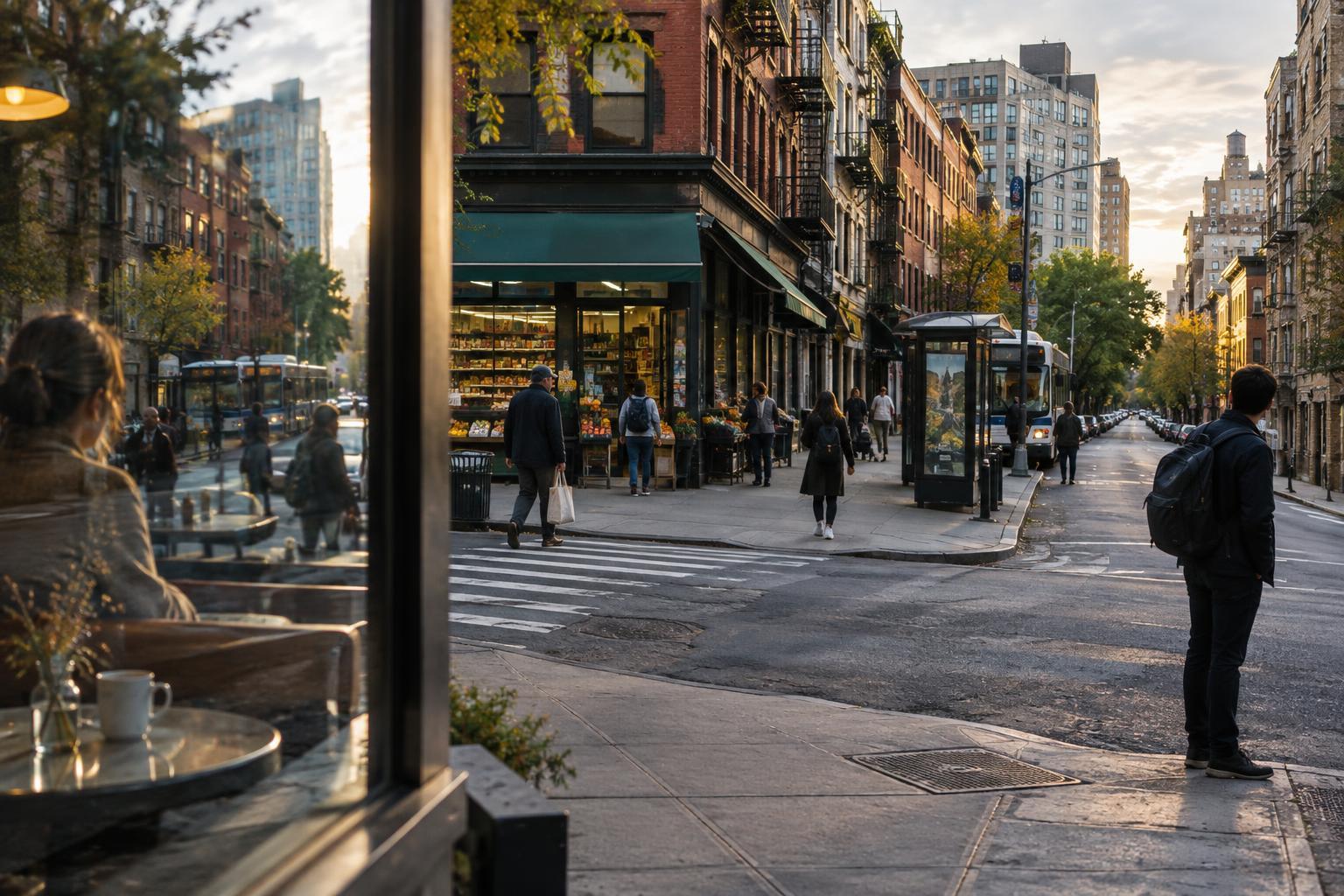
One way to test a portrayal is to ask whose routines are visible. Do residents do anything besides illustrate the central character’s experience? Are shops, parks and apartment buildings treated as places people use, or merely as scenery? Even a brief moment of ordinary purpose—a neighbor returning a borrowed item, a worker opening a storefront, a child taking a familiar route—can give a setting social depth. It suggests that life continues outside the frame.
Distinguish a character’s view from the story’s view
Characters are allowed to misunderstand cities. A newcomer may see a neighborhood as intimidating; someone returning home may find it changed beyond recognition. Those responses can reveal as much about the observer as they do about the place. A story becomes more interesting when it lets a character’s first impression meet resistance. The supposedly unfriendly street may hold a dependable network of neighbors. The celebrated district may be difficult to live in for reasons a visitor never notices.
Problems arise when a limited perspective is presented as the final word. If every description, plot turn and supporting character confirms the protagonist’s assumptions, the city has little chance to exceed them. A narrator need not deliver a corrective lecture. A disagreement, an overlooked detail or a resident with priorities unrelated to the protagonist can be enough to show the difference between seeing a place and knowing it.
Make room for change without turning it into a slogan
Cities change, and stories often use that change to explore memory, belonging or loss. Yet phrases such as “the city isn’t what it used to be” can flatten several experiences into one verdict. What changed, for whom, and at what cost? A shuttered café might represent a lost gathering place to one person and an unfamiliar landmark to another. A new building can alter daily routines without meaning the same thing to everyone nearby.
Specificity helps keep criticism honest. Instead of making a neighborhood stand for decline or renewal, a writer can follow how a change affects a route, a relationship or a shared space. Film can do something similar by returning to a location at different times of day or showing who remains after the main action passes through. Small observations do not settle large arguments, but they make room for people who experience a place differently.
A practical question for readers and storytellers
When reading or watching, try naming the job a city has been given. Is it a threat, a prize, a maze, an escape? Then look for anything that exceeds that job. Which characters know their way around without explaining the place to an outsider? Which spaces have uses that do not advance the plot? What would be lost if the story were moved to a generic city with the same skyline?
For storytellers, the goal is not to avoid recognizable images or to catalogue every contradiction. It is to choose details that belong to the particular story while allowing other lives to remain imaginable. A convincing city may be glimpsed only briefly, but it will not seem to have been built solely for the person passing through it. That sense of an inhabited world is often what separates an evocative setting from a stereotype.