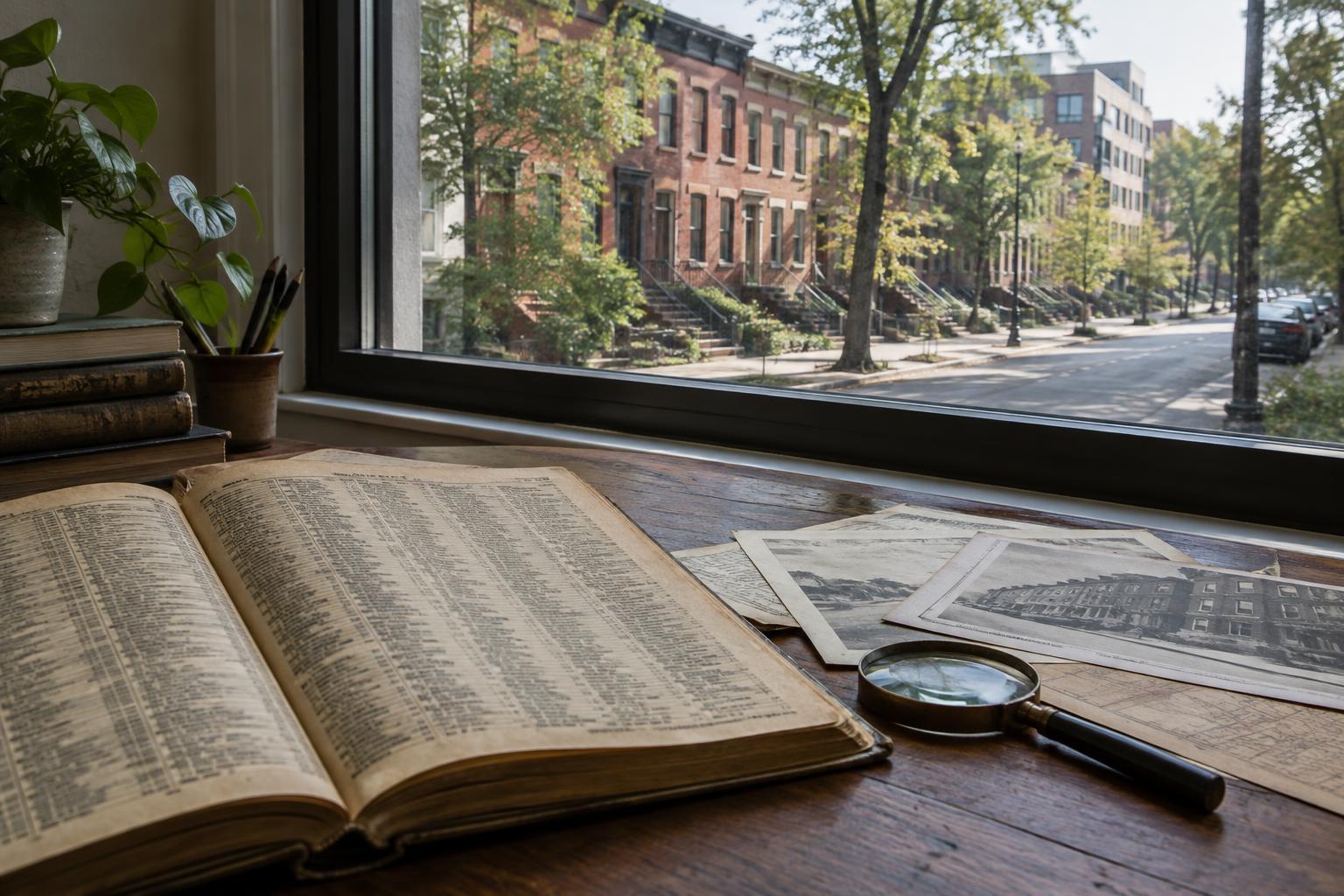
Start with an address, not a story
A city directory can make an unfamiliar street feel briefly populated. Where a present-day map shows a row of buildings, an older directory may list a tailor, a boarding house, a grocer or several people sharing one address. These entries offer useful starting points for exploring a neighborhood’s past. They do not, by themselves, tell you what daily life felt like or why anyone arrived or left.
Begin with a small question: Who or what was listed at one address over a span of years? Choose a building, a block or an intersection you can locate with reasonable confidence. Record the street name and number exactly as they appear today, then check whether either changed during the period you want to explore. Starting narrowly makes it easier to notice a change without assuming that every new listing represents a larger neighborhood trend.
Learn what each directory is organized to show
Directories vary. Some arrange residents by surname and include occupations; others have a street-by-street section, a business index or advertisements. Before collecting names, look at the opening pages and headings to see what kinds of entries the volume contains. Note its publication year, coverage area and any abbreviations it explains. A business may appear in more than one section, while a household may be represented by only one listed person.
Search an address in the street section if there is one, then use the alphabetical listings to learn more about the people named there. If you are working from scans, check the page image even when searchable text returns a result: print, damage and scanning errors can make a name or number hard to read. Keep a note of the exact directory and page for each finding so you can return to it later.
Compare entries without turning gaps into facts
A single listing is a snapshot made for a particular purpose. A sequence of directories is more revealing. Create a simple table with columns for year, address, listed name, occupation or business, and questions to follow up. Look for repeated names, shifts in businesses and changes in how a property is described. Several households at one address might suggest a different use of a building than a single storefront listing, but the directory alone may not establish how the space was divided.
Treat an absent entry cautiously. A missing name could reflect a move, a spelling variation, an omission or a change in the directory’s coverage. Street renumbering can make a stable building appear to vanish. If a pattern matters to your account, compare nearby addresses and check another kind of record, such as a historical map or photograph, when one is available. The aim is not to eliminate every uncertainty; it is to make clear which details are documented and which remain interpretations.
Notice whom the directory makes hard to see
Directories can privilege people and businesses that their compilers found easy or worthwhile to list. A named resident does not stand for everyone who lived in the household. Children, lodgers, workers, people with unstable housing and those excluded by a directory’s practices may be difficult to find. An occupation beside a name can be informative, but it cannot describe a person’s whole working life or standing in the community.
Read advertisements and business categories with similar care. They can show how a business presented itself or how a publisher grouped local trades, not necessarily how neighbors understood the place. If you are writing about identity or belonging, avoid treating a surname or occupation as proof of someone’s background or experience. Directories are strongest when they help you ask better questions, rather than when they are asked to answer questions they were never designed to record.
Build a neighborhood account that leaves room for change
Once you have traced a few addresses, step back and consider the block. Did certain kinds of shops appear repeatedly? Did the same households remain while nearby listings changed? These comparisons can give shape to an account of continuity and turnover, especially when paired with maps, photographs or recollections. Keep the scale of your conclusions close to the scale of your evidence: a few entries can illuminate a corner without explaining an entire city.
A compelling neighborhood history need not resolve every mystery. You might write around an ordinary address that changed uses, or follow a business name across several listings before it disappears from the record. Include the limits of what you found as part of the story. That honesty makes space for the lives a directory compresses into a line of print—and for the neighborhood that existed beyond its pages.