Begin with the ordinary exchange
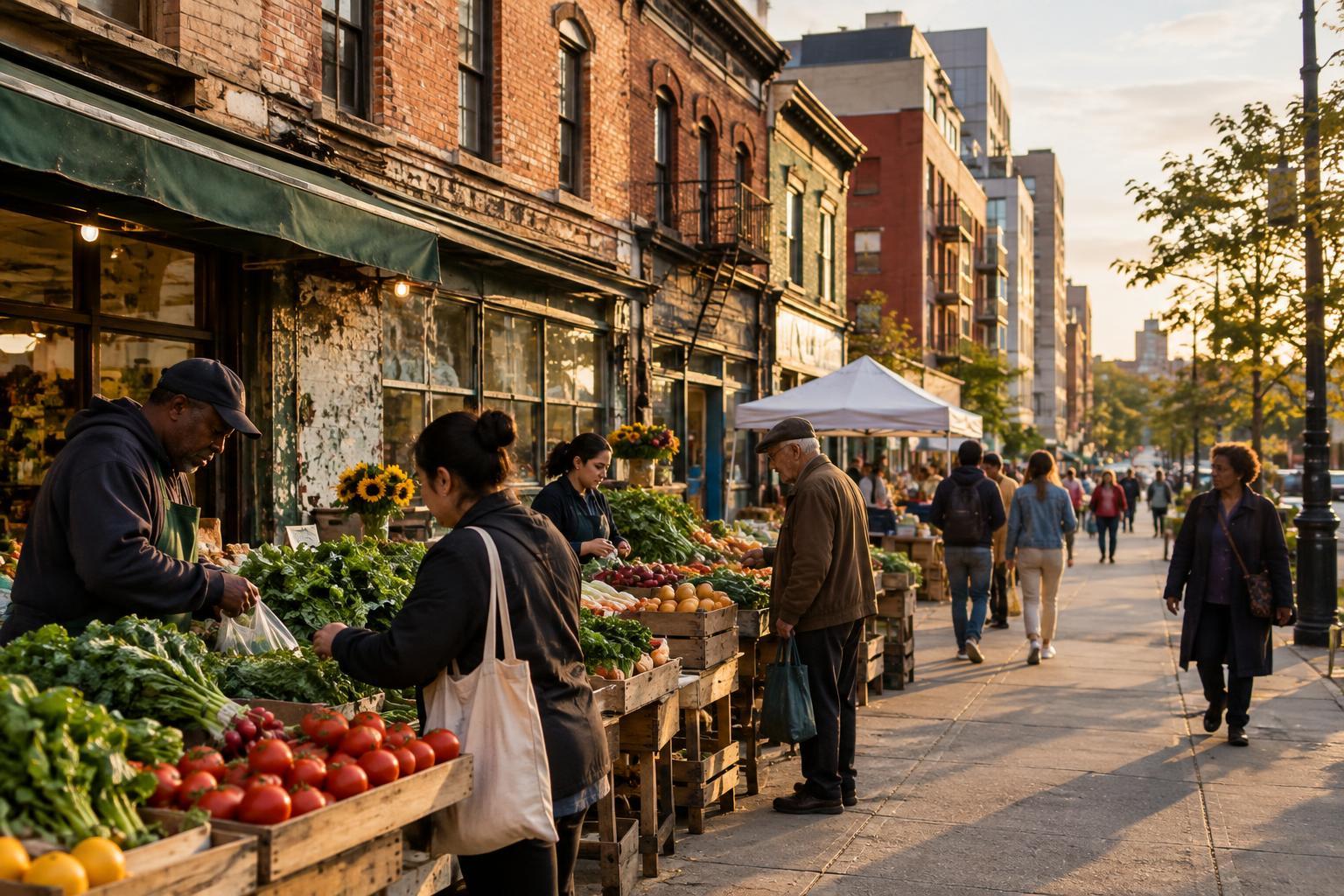
A neighborhood’s history is often told through its landmarks: a grand station, an old theater, a building that survived while others did not. A marketplace asks us to look at smaller encounters. Someone buys bread on the way to work. A shopkeeper remembers a customer’s usual order. Two neighbors stop to talk beside a produce stall. These exchanges may leave little formal record, yet they help give a street its rhythm.
“Marketplace” need not mean a single covered hall or a row of permanent shops. It might be a weekend gathering of vendors, a corner store, a cluster of businesses around a transit stop or a stretch of sidewalk where people have long met and traded. Following commerce through such places offers a way to ask who lived nearby, what they needed and how they used the city. It also shows that buying and selling are never the whole story: a place of trade can be a place to share news, find work, practice a language or simply be recognized.
Read the street as a changing record
The physical layout of a commercial street can hold clues to earlier ways of life. Narrow shopfronts may invite frequent stops on foot; loading doors and rear lanes suggest other patterns of movement and delivery. A former storefront used as a home, or a shop that has become a café, points to change without explaining it on its own. The useful question is not only “What was here before?” but “What made this use possible, and what made it difficult to keep?”
Signs, window displays and the goods for sale can suggest whom businesses hope to welcome. They should not be treated as a complete account of who belongs. A street can serve residents who rarely appear in its advertisements, while a familiar sign can remain after the business behind it has changed. Even an empty unit has more than one possible story. Rent, a proprietor’s retirement, shifting demand or a building’s condition might all matter. Careful attention begins with what is visible, then leaves room for what cannot be learned by looking.
Listen for the histories that buildings cannot tell
A marketplace lives partly in people’s habits: which route felt quickest, where someone was allowed to linger, which counter offered a familiar greeting. Ask different people about the same block and they may remember different places. A child might recall a sweet shop; a worker, the earliest place open before a shift; a vendor, the effort of setting up in bad weather. None of these accounts cancels the others. Together they make the history of a place more textured.
Memory also has limits. People may compress several decades into one scene or remember a business as permanent because it mattered deeply to them. Rather than treating these gaps as failures, a writer can distinguish between what a person recalls and what can be established from other records. The distinction protects both the story and the person telling it. It makes space, too, for people whose labor sustained a marketplace but whose names never appeared above a door: assistants, cleaners, delivery workers and family members who helped behind the counter.
Write about change without making the past stand still
Stories about neighborhood commerce often turn toward loss. A shop closes; a familiar smell disappears; a new storefront seems to address a different customer. Such changes deserve attention, especially when they affect where people can afford to work, shop or gather. But nostalgia can flatten a complicated past. An old marketplace may have offered belonging to some people while excluding others, and a newer business may become meaningful to its own regulars.
A more useful account follows relationships as well as replacements. What happens to a conversation when a counter closes? Where do customers go when a useful service moves? Which routines survive in a different location, and which depended on a particular doorway or person? These questions keep the focus on people rather than on a simple contrast between “then” and “now.”
To follow a marketplace through time is to notice how a neighborhood remembers itself in daily practice. Buildings and business names provide one set of traces; greetings, errands and repeated journeys provide another. Neither tells the whole story. Held together, they show why commerce can matter beyond a purchase: it gives people reasons to cross paths, and those crossings become part of a place’s memory.