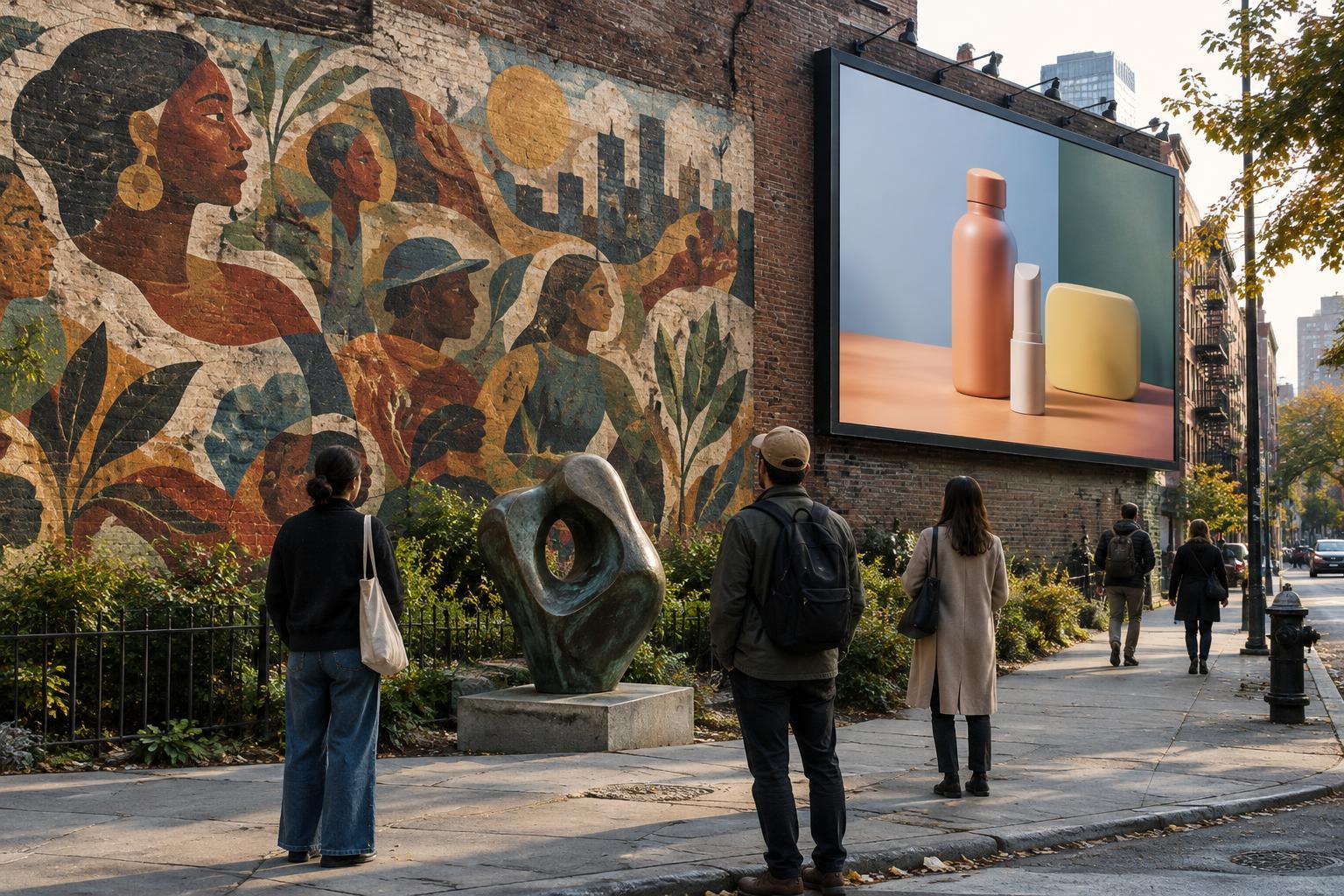
The street is a crowded page
A walk through a city can feel like reading several texts at once. A mural covers a wall beside a shop sign. A transit shelter carries a campaign. A sculpture marks a square where someone has taped up a notice for a missing pet. These messages differ in scale and purpose, yet they share a basic condition: people encounter them while going about their lives, often without choosing to look.
That makes the familiar opposition between public art and advertising less tidy than it first appears. A painted wall may invite reflection, sell a product or do both. An advertisement may borrow the visual language of protest or local history. Rather than deciding what a work is by its appearance alone, it helps to ask how it came to occupy the space and what kind of attention it seeks.
Ask what the message wants
Advertising usually has a defined goal: to encourage a purchase, build recognition or change a person’s behavior on behalf of a sponsor. Even when its story is moving or its design is inventive, the message tends to guide the viewer toward an outcome. Public art can also persuade, celebrate or provoke, but it need not resolve a viewer’s response so neatly. A work might leave room for disagreement, memory or questions that cannot be answered on the spot.
Purpose is not the same as quality. An ad can be visually compelling, and a commissioned artwork can be dull. Nor is every call to action commercial: a community-made poster might ask neighbors to attend a meeting. The useful distinction is not whether a message is beautiful or whether it persuades. It is who benefits from that persuasion and how much freedom the viewer has to interpret or refuse it.
Follow the permission and the money
Placement tells another part of the story. Who owns the wall, shelter or square? Who paid for the work, approved its design and can remove it? An artwork in a public setting may still be controlled by a private property owner or shaped by a sponsor. An informal memorial may have no official permission yet speak directly to the people who use a place. None of these arrangements automatically determines a message’s value, but each affects whose expression is likely to remain visible.
Funding can make ambitious work possible while also setting limits on it. A sponsor might support a mural about neighborhood identity but prefer a comforting image to one that examines conflict. A city commission may invite broad participation, or it may define the subject before residents can weigh in. When reading a work, look for what is present and what feels conspicuously absent. Then treat those impressions as questions rather than proof of anyone’s motives.
Notice who is being addressed
A message in shared space may speak differently to a visitor, a commuter and someone who lives nearby. Images described as celebrating a neighborhood can seem welcoming to one viewer and flattening to another. A billboard aimed at drivers may dominate the view from a nearby home. Asking who is meant to recognize themselves in a work—and who must live with it after others pass through—brings the audience into focus.
This is also why local context matters more than a quick photograph can show. The same image can take on different meanings beside a school, across from a former workplace or on a wall with a history of community notices. You do not need to know every history before responding to what you see. You can start by noticing your own position: Are you passing through, returning daily or looking at someone else’s familiar surroundings?
Practice a slower kind of looking
On your next walk, choose one cluster of messages rather than trying to judge an entire district. Read the words, then look at the size, height and direction of each image. Notice which messages require you to stop and which can be understood at a glance. Ask what would be lost if one were removed and what, if anything, could appear in its place. These simple observations can reveal how attention is distributed along a street.
Public art and advertising are not separate worlds sealed off from one another. Both use shared space, visual skill and the stories people already carry. Reading them critically does not require dismissing pleasure in a bright sign or demanding that every mural deliver a lesson. It means recognizing that visibility is a resource. Once we ask who gets to use it, a familiar route can become a conversation about the place we share.