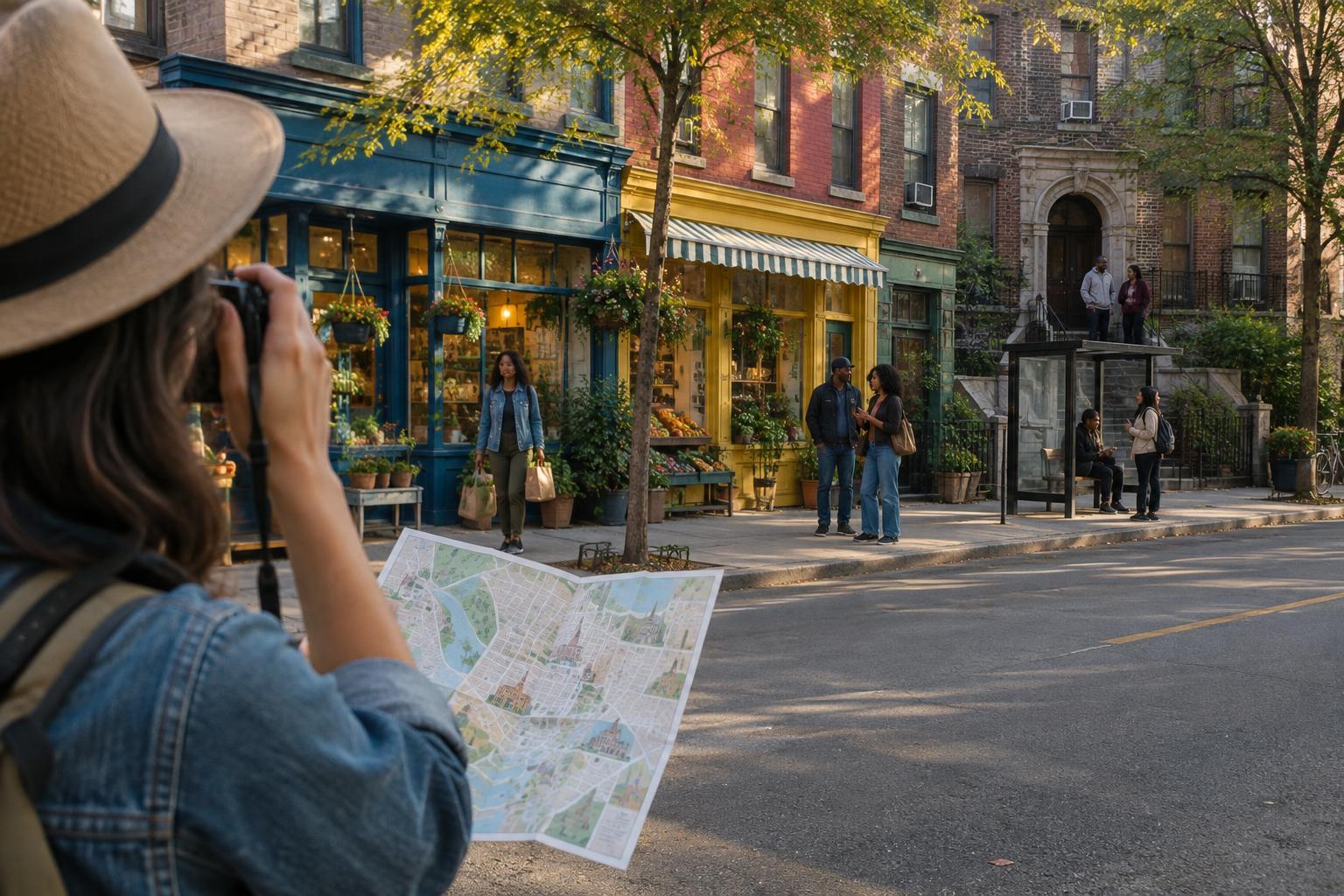
From place to promise
A tourism campaign has a difficult task: make a place legible to someone who has never been there. It may have only a photograph, a short phrase and a few suggested stops to work with. A neighborhood, meanwhile, is an accumulation of ordinary routines, conflicting memories, private spaces and changing relationships. Branding begins when that complexity is arranged into a promise a visitor can quickly understand: come here for food, creativity, history or a certain kind of street life.
There is nothing inherently false about choosing a theme. A district may have a strong arts scene or a meaningful architectural history. The problem begins when a useful introduction hardens into the neighborhood’s whole identity. If every image shows colorful storefronts and cheerful pedestrians, the campaign can make work, disagreement and daily inconvenience seem out of place. The brand does not need to lie to be selective; selection is how it works.
The familiar tools of neighborhood branding
Campaigns often build recognition through repetition. A mural appears in advertisements, on maps and in social posts. A few restaurants become stand-ins for an entire food culture. Words such as “authentic,” “hidden” or “up-and-coming” offer visitors a ready-made way to feel adventurous. Together, these choices create a mental route through the neighborhood before anyone arrives.
Look closely at what the route includes. Does it connect public landmarks to locally owned businesses, or does it treat streets mainly as attractive backdrops? Are buildings described through their design while the people who use them remain anonymous? Even a campaign that celebrates cultural diversity can flatten it if different communities appear only as cuisines, festivals or decorative details. Culture is not simply a set of experiences available for purchase; it is also made through care, labor and long-standing ties.
Who gets to tell the story?
The voice of a campaign matters as much as its images. Promotional copy can speak as though a neighborhood has just been discovered, even when residents have spent generations making it a home. It can describe change as an uncomplicated improvement without asking what has been lost, or use a community’s history to give a new development a sense of depth. Such language positions the visitor as the main character and residents as part of the setting.
A more careful approach does not require one official story. Residents, workers, artists and business owners may disagree about what deserves attention or how visitors should behave. That disagreement is itself evidence that a neighborhood is lived in rather than staged. Campaign makers can make room for named local perspectives, explain why particular sites matter and avoid presenting one aesthetic as the voice of everyone. Participation should mean more than asking people to decorate a story whose conclusion has already been written.
Attention brings trade-offs
Visitor attention can support shops, cultural spaces and public events. It can also change how a street is used. A sidewalk that serves as a route to school or work may become a photography stop; a small business may gain customers while facing pressure to perform a narrow version of “local character.” These effects vary by place, so neither celebration nor condemnation is enough on its own.
One useful question is who benefits from the attention and who bears its costs. Does the campaign direct visitors toward businesses that want them? Does it offer guidance about residential areas and shared space? Does it acknowledge that a popular destination is also somewhere people need to run errands, rest and maintain relationships? A good visitor invitation can be enthusiastic without suggesting that access to every corner is part of the purchase.
How to read a campaign with care
When you encounter a neighborhood campaign, start with what it asks you to notice. List the recurring images, adjectives and stops. Then consider what falls outside the frame: homes, workplaces, places of worship, ordinary services or histories that do not fit a cheerful itinerary. Absence alone does not prove bad intent, but patterns of absence tell you what kind of visitor the campaign imagines.
Next, listen for agency. Who is quoted or credited, and who is described from a distance? Is the neighborhood presented as a finished product, or as a place where people continue to make choices? Finally, compare the invitation with the behavior it encourages. A story can spark curiosity while still reminding visitors to follow local guidance, respect private space and support the people whose work makes a visit possible. The most revealing question is not whether a brand captures a neighborhood perfectly. None can. It is whether the brand leaves room for the neighborhood to be more than its promise.