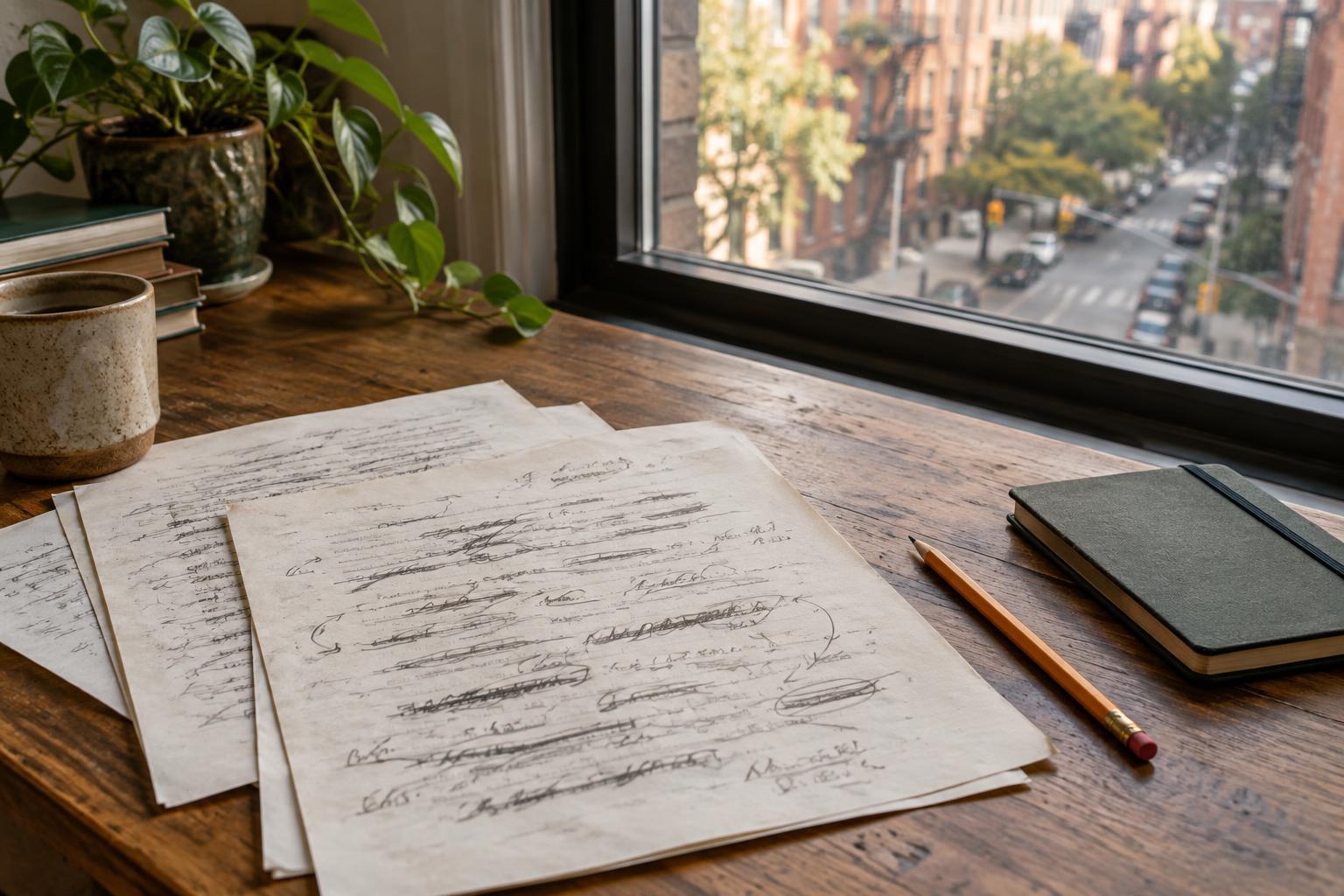
Find the sentence beneath the sentence
Clarity is not the same as simplicity. A long sentence can be clear, and a short one can leave a reader stranded. The useful question is not “Can I make this shorter?” but “Can a reader follow what is happening, to whom, and why it matters?” Start by reading the sentence once without editing. Then state its central action in plain words. If you cannot do that, you may be trying to carry several ideas at once.
Consider a sentence about a familiar street: “After the shops had closed, and despite the buses still moving through it, the block, which I had known since childhood, seemed different.” Its point might be that the speaker no longer recognizes the block. Bringing that perception forward gives the reader a foothold: “I barely recognized the block after the shops closed, though buses still passed through it.” This version is not automatically better. It is a test of what the sentence is doing. Once you know its center, you can decide which detours, pauses, and details deserve to remain.
Clear the path, not the texture
Readers can usually handle unfamiliar words or intricate images when the relationships between ideas are steady. Confusion often comes from an unclear “it,” an action buried far from its subject, or a modifier that might describe more than one thing. Check those connections before replacing vivid language with generic language. “The train carried a tired light into the station” may be unusual, but its image is easy to locate. If “it carried a tired light there” follows a paragraph about several trains and stations, the pronouns may be the problem, not the image.
Look for places where a reader must stop to identify who is speaking, what a phrase refers to, or when an event occurred. Supply the missing name or move a phrase closer to the word it describes. In dialogue, a small attribution can do more for clarity than rewriting a character’s entire line. In a passage that moves between past and present, one precise time marker may be enough. These are targeted repairs: they preserve the sentence’s personality while making its route visible.
Listen for the work your rhythm is doing
Voice often lives in timing. A string of short sentences can convey impatience or certainty. A sentence that delays its main clause can create anticipation. Repetition can sound insistent, tender, comic, or uneasy. Before cutting a repeated word or dividing a long sentence, read the passage aloud and ask what its pace contributes. You might stumble because the syntax is tangled; you might also pause exactly where the emotion requires a pause.
Try two versions of a difficult sentence. In the first, make the order of events unmistakable. In the second, restore any rhythm that the clearer version lost. Suppose you begin with “I went back to the corner, to the door, to the painted-over sign.” A compressed revision such as “I revisited the building” conveys the basic action but erases the searching movement. You could instead clarify the setting around the original line and leave its repetition intact. Revising for clarity sometimes means changing the neighboring sentence rather than the sentence that first caught your eye.
Diction deserves the same care. A surprising verb or a word drawn from a character’s particular way of seeing may be more valuable than a familiar substitute. Keep it if the surrounding sentence gives readers enough to understand its role. Replace it if its sound appeals to you but its meaning works against the passage.
Test the revision in context
A sentence has two jobs: to make sense on its own terms and to belong where it appears. After revising, read the paragraph from the beginning. Does the sentence pick up a detail the reader already knows? Does it introduce a new image at a moment when the paragraph needs direction? A perfectly orderly sentence can feel flat if it explains what the preceding lines have already made vivid. Another may be clear in isolation but jarring in the voice of its narrator.
One practical method is to mark the point where your attention slips while reading. At that spot, ask a specific question: Who does this pronoun name? Which event came first? Is this image meant literally? Answer only the question the passage actually raises. Then compare the revised version with the original and notice what has disappeared. If you have lost a useful beat, a distinctive word, or a deliberate uncertainty, put it back and solve the confusion another way.
Not every uncertainty is a flaw. A story may withhold a character’s motive, and a poem may let an image hold more than one meaning. The distinction is between an open question that invites attention and a broken connection that forces guesswork. Aim to remove the guesswork while leaving room for discovery. The result should still sound like a person making choices, not a sentence polished until nobody could have written it.