Start with what the label asks you to see
An exhibition label can look like a neutral companion to an artwork: a title, a maker’s name, a date and a short explanation. Yet even a brief label makes choices. It may direct your eye toward a material, describe a historical setting or suggest an emotion the work is meant to evoke. Those choices do not necessarily make the label misleading. They make it an interpretation worth reading, rather than a set of instructions to accept.
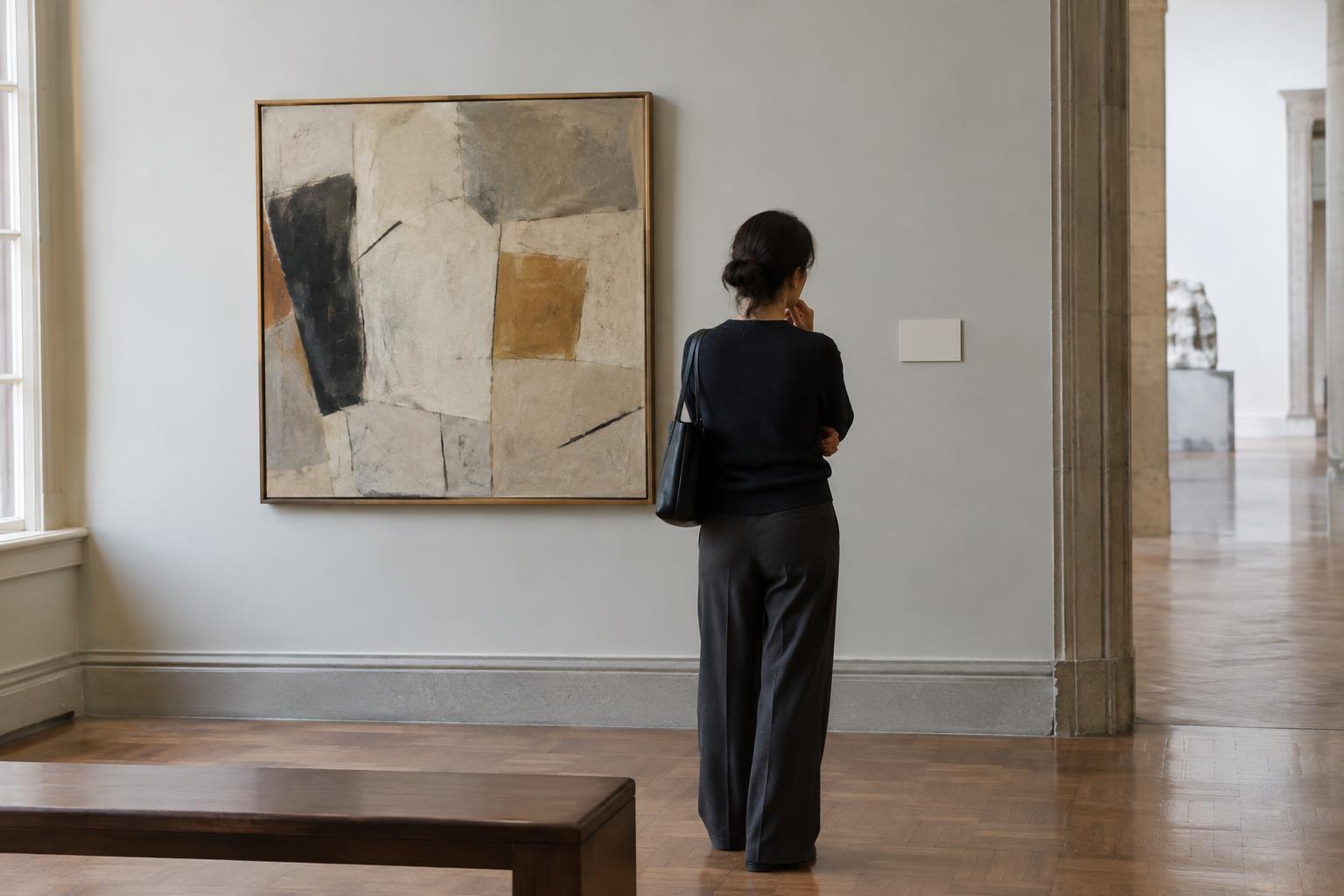
Before reading the text, spend a moment with the work if you can. Notice what first catches your attention and what questions arise. Then read the label and ask what changed. Did it help you see a detail you missed, or did it lead you away from something you found important? Neither response has to be a verdict on the exhibition. The comparison simply shows how interpretation can shape an encounter.
Notice what receives context
Labels have limited space, so they cannot explain everything. A curator might use that space to discuss technique, a maker’s biography, the work’s original setting or its relationship to other objects nearby. Each emphasis offers a different path into the work. A label focused on materials might help you understand how an object was made, while leaving its social setting largely unexplored.
Look for patterns across several labels, not just one. Are some makers introduced through their ideas while others are introduced mainly through their identities? Are certain places described in detail while others appear as vague backdrops? These questions do not prove that an exhibition has a single hidden agenda. They help you identify its recurring priorities and consider how those priorities affect the story it tells.
Listen for certainty and interpretation
A label may move quickly from observable description to a claim about meaning. “The figure stands beside an open window” describes something a visitor may be able to see. “The figure longs to escape” proposes an interpretation. Both sentences can be useful, but they do different work. Words such as “suggests,” “may” or “has been understood as” can signal that a reading is open to discussion.
Pay particular attention when a label assigns intentions to a maker or describes what an entire community believed. Those claims may require more context than a short wall text can provide. You need not reject them on sight; instead, ask what in the work or surrounding exhibition supports them. If the basis is unclear, you can hold the claim as one possible reading while continuing to look for others.
Ask whose voice you are hearing
Labels often speak in an institutional voice, even when they draw on a maker’s words or a community’s knowledge. Notice when a statement is attributed and when it is not. Does the text distinguish between what a maker said, what a curator proposes and what a visitor can observe? Attribution matters because it lets you understand the relationship between a claim and the person making it.
Absence calls for care. A label that does not address a question you have is not, by itself, evidence that the exhibition ignored it. The answer may appear elsewhere, or space may have required a narrower focus. Still, unanswered questions are worth keeping. If an exhibition presents an object made for use in a particular place, for example, you might wonder how its meaning changes when it is displayed away from that setting.
Read between the text and the work
Critical reading need not turn every gallery visit into a hunt for errors. Try moving back and forth between the label, the work and neighboring displays. Ask which details the text helps you notice and which details it cannot settle. When you disagree with a label’s emphasis, put your alternative into words: what do you see, and why does it matter? That is a stronger response than simply calling the text wrong.
The aim is not to find a perfect label. It is to recognize that a few sentences can open a work up while also narrowing the path through it. Carrying your own questions into an exhibition makes room for both the curator’s interpretation and your direct attention. For further browsing on exhibition settings and displays, explore Galleries and Exhibitions · The Artful Guide.