Give the notebook a job, not a standard to meet
A writer’s notebook does not need to be a beautiful record of your days. Its job is to hold material you might otherwise lose: a turn of phrase, a question, an overheard rhythm, an image from the bus window, or a problem in a draft. Messy entries are useful if you can return to them. An empty notebook kept for only your best thoughts is less helpful than a battered one full of possibilities.
Choose a format that fits the moments when ideas tend to arrive. A small paper notebook may suit walks and commutes; a notes app may be easier when you have only one hand free. You can use both. If you do, decide where entries will eventually meet, even if that simply means reviewing your phone notes once a week and copying over anything worth keeping. The best system is the one you will use without preparing for it first.
Collect specific details before trying to interpret them
When you notice something, write down what is actually there before deciding what it means. “A lonely street” may express your reaction, but “three lit windows above a closed bakery” gives you something to work with later. Record sounds, gestures, fragments of language, changes in light, or the way a familiar place looks after a detour. You can add your interpretation alongside the detail rather than letting it replace the detail.
Questions belong in the notebook too. Why does one corner of a neighborhood feel like a boundary? What does a character keep in a kitchen drawer? Which word would a speaker refuse to use for home? You do not need answers on the spot. A precise question can become the beginning of a poem, a scene, or a piece of criticism. When writing about people you encounter, consider their privacy: you can preserve a revealing gesture or speech pattern without turning a stranger’s identifiable experience into your story.
Make room for several kinds of entry
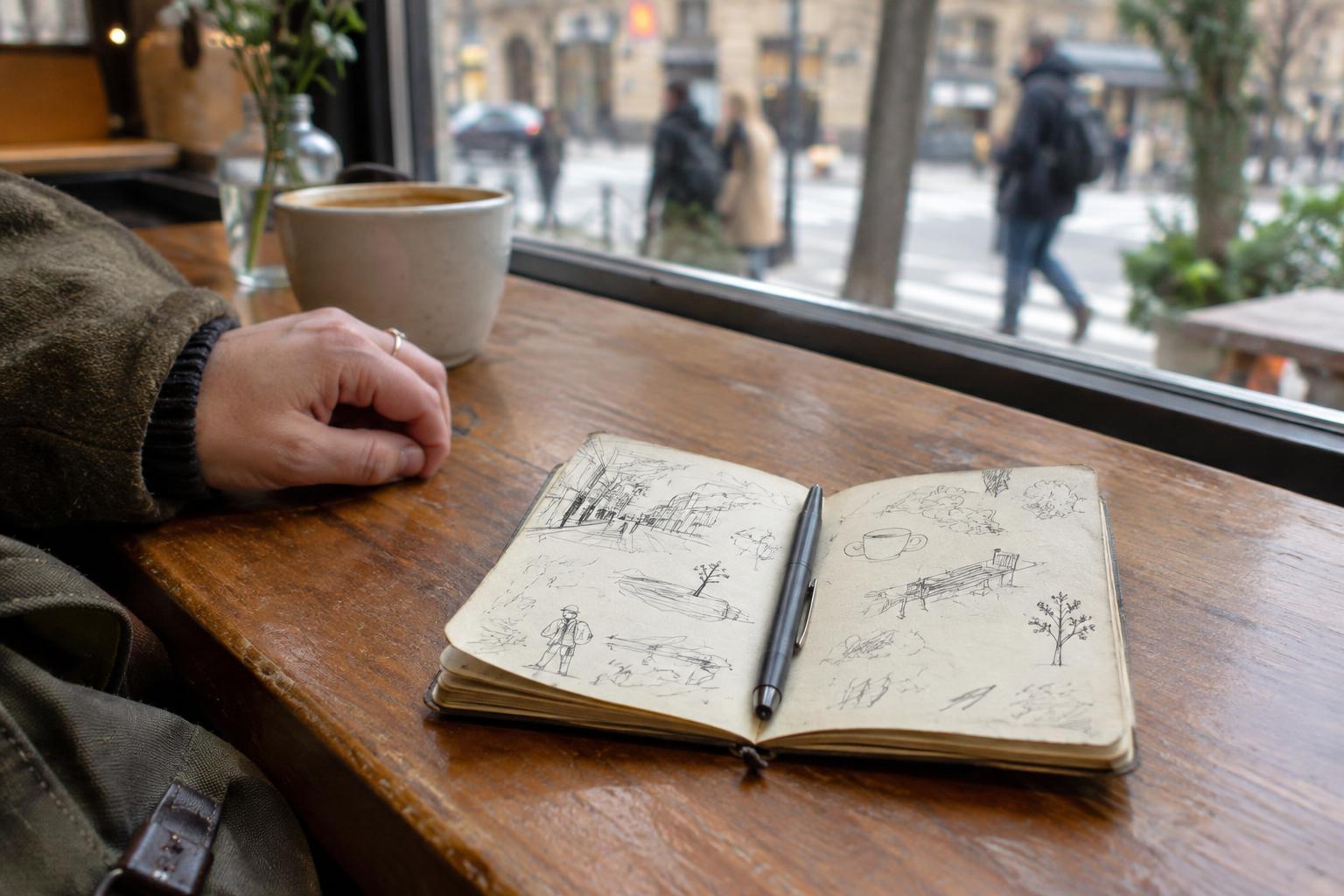
If every page must contain a polished idea, opening the notebook becomes difficult. Give yourself a few low-pressure ways in. Keep lists of titles, objects, place names, or words you like the sound of. Sketch the shape of a scene in three lines. Write a sentence that begins “I keep noticing…” and see where it goes. On a day when nothing seems interesting, describe the route you took or the room you are in, including one detail you would usually overlook.
It can help to distinguish raw material from work in progress. You might mark a possible story with “S,” a poem with “P,” and a question to investigate with “?”. Keep the marks simple enough that you can use them while standing on a train platform. They are signposts, not filing rules; an image first marked for a poem may later find its way into fiction.
Build a small habit of returning
Capture is only half of the practice. Set aside a short, regular time to reread recent entries, perhaps at the end of a week or before a writing session. Underline what still catches your attention. Put a star beside anything you want to test in a draft. Cross out nothing unless it gets in your way; an entry that seems flat today may become useful when it meets another one.
Look for connections rather than a single perfect idea. Two descriptions of different streets might suggest a setting changing over time. A remembered argument and a note about a locked door might create the tension for a scene. Copy promising fragments onto a fresh page and ask what each one could do: establish a voice, complicate a character, sharpen an image, or pose a question the piece cannot yet answer. This step turns storage into practice.
Let the notebook change with your writing
A notebook should support the work you want to make, not dictate it. If you are drafting short fiction, you may start recording bits of dialogue and decisions characters avoid. If you are writing poetry, you may pay closer attention to sounds, line breaks, and words that carry more than one meaning. For an essay about a city, you might collect descriptions of the same place at different times and note where your own memory is uncertain.
After a few weeks, notice what you actually reach for when you write. Keep those kinds of entries easy to make, and drop any elaborate routine you keep postponing. Some days the notebook may hold a single sentence; other days it may fill several pages. The measure of its value is not how consistently it looks like a writer’s notebook. It is whether it helps you pay attention, return to your questions, and begin again.