A line ending is a moment of attention
In prose, a sentence usually runs until punctuation tells us to stop. In a poem, the right edge of a line offers another kind of signal. Even when the sentence continues, the final word receives a moment of attention before the eye moves down. A poet can use that moment to make an ordinary word feel charged, to let an image settle, or to create a small expectation about what comes next.
That expectation is part of a line break’s meaning. Consider an invented phrase that ends with “I kept the light.” For an instant, the speaker might seem to be holding on to brightness or hope. If the next line begins “from reaching the street,” the action changes: keeping the light becomes an act of blocking it. The full sentence matters, but so does the temporary reading made possible by the break. A line can let readers hold two understandings in sequence without having to state either one outright.
End-stopped lines and lines that carry on
An end-stopped line closes with punctuation or a clear grammatical stopping point. It can give an image room to stand on its own: a door shuts, a voice falls silent, a scene comes briefly to rest. A line that runs into the next without such closure is often called enjambed. It creates a different experience, inviting the reader forward to complete a thought. Neither choice is automatically faster or slower; their effect depends on the words, syntax and surrounding lines.
A heavily punctuated poem may still feel urgent if its sentences are short and forceful. An enjambed poem may feel hesitant if each line ending leaves an unsettling question. Read the line and ask what it permits you to know before you continue. Does it offer a complete statement, or does it leave a verb waiting for an object? Does the next line confirm your first impression or revise it? Those small shifts can shape the emotional pace as much as the number of syllables can.
The space between speech and the page
Line breaks are visible, but they are not always instructions to take a full breath. In a reading aloud, syntax may carry the voice across the break. A slight change in emphasis, rather than a long pause, may be enough to register the line ending. If every break is treated as a stop, a flowing sentence can become choppy; if none is acknowledged, the poem’s arrangement may lose some of its force.
The page also gives line breaks a spatial role. A short line can draw attention to a single word, while a long line can allow a description or argument to gather momentum. A shift from long lines to short ones may make a speaker seem newly cautious, though it could suggest many other things in a different poem. Think of line length as a choice that works with sound and grammar, not a code with one fixed meaning. The same word can feel like an arrival at the end of a line and a departure at the start of the next.
A practical way to revise your breaks
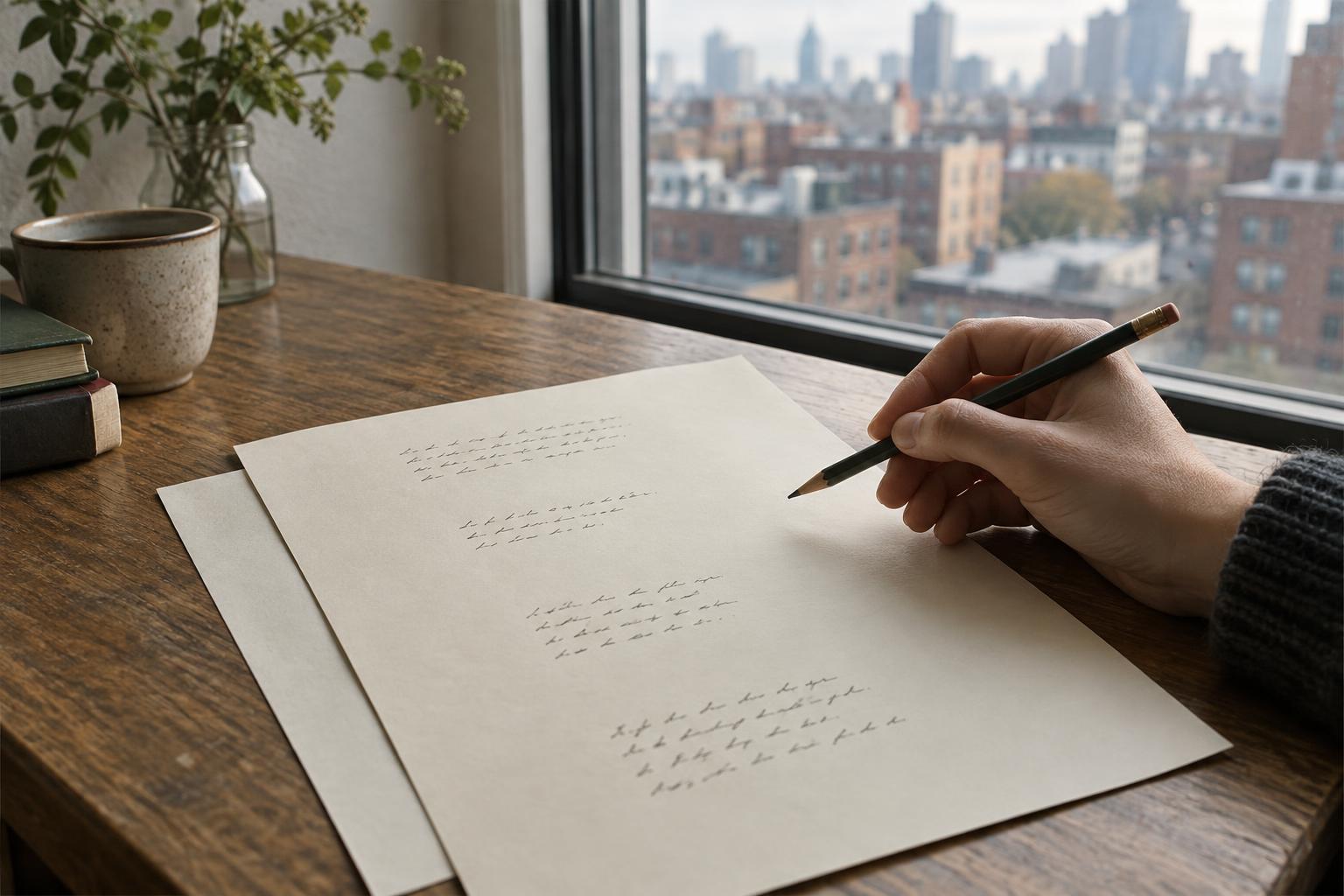
Take four or five sentences from a draft and copy them into a few different line arrangements without changing the words. In one version, end lines at natural pauses. In another, break just before a key noun or verb. In a third, place an important word at the end of a line. Read each version silently, then aloud. Notice where your attention lands, what you expect at each edge, and whether the next line makes that expectation more interesting.
Keep the arrangement that serves the poem’s larger movement, not merely the one with the most surprising breaks. A pause that gives a remembered street or room its own space may help a poem about place; elsewhere, an unbroken rush of language may better convey a crowded moment. If a break creates confusion you do not want, move it. If it opens a useful second meaning, see whether the surrounding lines make that possibility worth holding. The strongest break is one that gives the reader a reason to cross it.