The difference is rhythm, not rhyme
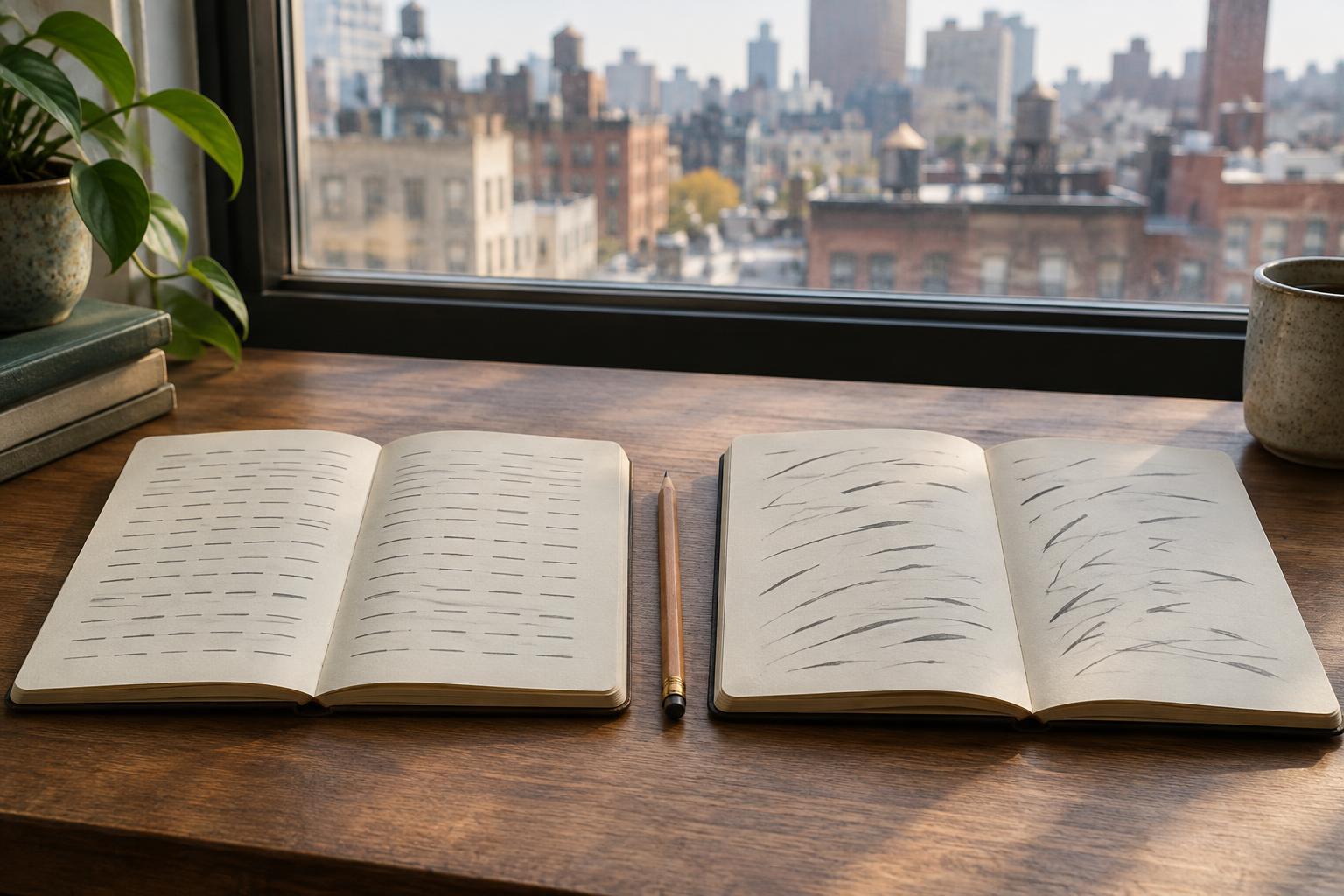
A poem does not become free verse simply because its lines do not rhyme. Blank verse also goes without a regular pattern of end rhyme. The key difference is meter: blank verse is written chiefly in unrhymed iambic pentameter, while free verse does not follow a fixed metrical pattern.
An iamb is a pair of syllables that moves, in its simplest form, from a lighter stress to a stronger one. Pentameter gives the line five such beats. English speech rarely falls into perfect pairs, so blank verse can bend that pattern without abandoning it. Free verse has no comparable beat to return to across the poem. Its rhythms may arise from speech, repeated words, sentence length, pauses or the placement of line breaks.
How blank verse holds a flexible pattern
The regular pulse of blank verse gives a poet something to work with and against. A line might begin with an unexpected strong stress, pause in the middle or end before its sentence does. Those departures become noticeable because the underlying meter has prepared the ear for something else. The form can therefore sound conversational while retaining a quiet sense of measure.
To get a feel for the pattern, read this invented line aloud: “The streetlights fade beneath the morning rain.” Its stresses can be heard as a series of rising beats, though a reader may give particular words more weight. The point is not to pronounce every line mechanically. It is to hear whether a recurring five-beat movement shapes the poem as a whole.
A single roughly iambic line does not make an entire poem blank verse. Look for the pattern across several lines, allowing for variation. End rhyme may occasionally appear by chance, but a sustained rhyme scheme would change how we describe the poem’s form.
How free verse finds its shape
Free verse is free from a required meter, not from decisions. A poet still chooses where a line begins and ends, which sounds recur, and how much room to give an image or thought. Some free-verse poems use short, abrupt lines to slow the reader down. Others let long sentences spill across the page, creating a sense of movement or accumulation.
Consider these two ways of breaking a phrase: “I waited at the corner / for the bus” and “I waited / at the corner for the bus.” The words stay the same, but the first break briefly leaves the speaker at a particular place; the second emphasizes the act of waiting. That moment of suspense is one reason lineation matters in free verse. It matters in blank verse too, although there the line also carries a metrical expectation.
Free verse can use repetition, alliteration, recurring images or occasional rhyme. It may even contain a line that sounds metrical. What makes it free verse is the absence of a governing fixed meter, not the absence of musical language.
A practical way to tell them apart
First, set rhyme aside. Read several lines aloud at a natural pace, listening for a recurring five-beat, rising movement. If you hear one, try reading on: does the rhythm return after pauses and variations? That persistence suggests blank verse. If the lengths and stresses change without a regular metrical foundation, you are more likely reading free verse.
The distinction is not always obvious at a glance. Typography alone cannot settle it, and a strongly rhythmic passage of free verse may briefly resemble blank verse. Reading a whole passage is more useful than counting syllables in one line. It also helps to ask what organizes the poem when the sound shifts: a repeating meter, or another pattern such as syntax, image or refrain?
Choosing a form for your own poem
If you want a steady current beneath changing speech, try blank verse. Draft a few unrhymed lines with five beats each, then read them aloud and adjust any wording that feels forced. You need not make every line identical; the interest often lies in how a natural sentence presses against the meter.
If you want the line length to respond more directly to a shifting thought, try free verse. Write the passage first, then move its breaks. Notice where each version invites a pause, creates emphasis or delays a word. In either form, the useful question is not which one is freer. It is what kind of attention the poem asks of its reader, and how its lines make that attention possible.