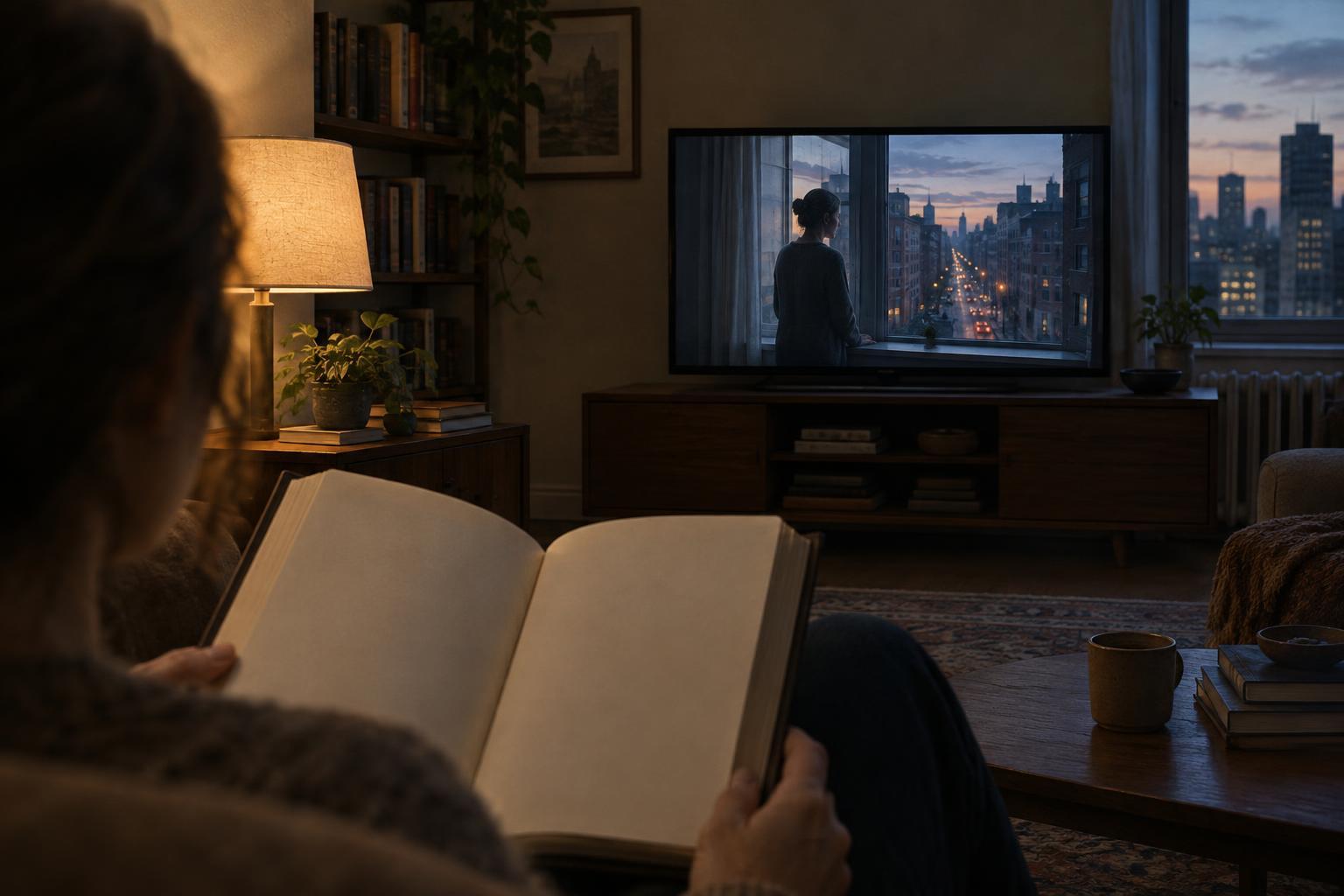
Start with the audience’s position
When a novel becomes a film or television series, the plot may look familiar while the experience of following it changes. A reader can spend pages inside one character’s thoughts. A viewer may watch that character from across a room, hearing only what they choose to say. The useful question is not simply whether the adaptation is faithful. It is: where does each version place its audience, and what can the audience understand from there?
Before comparing individual scenes, identify what each version lets you know at the beginning. Does the novel disclose a fear or desire that the screen version keeps hidden? Does the adaptation show an event the book only reports afterward? These choices shape suspense and sympathy. The same action can feel like a mistake when readers know a character’s intentions, but like a threat when viewers must infer those intentions from behavior.
Notice how private thought becomes public evidence
Prose can move between an event and a character’s interpretation of it in a sentence. A narrator might describe a crowded street and then reveal that its noise reminds someone of home. On screen, a crowded street is immediately available to the viewer, but the memory is not. An adaptation might use a conversation, a repeated sound, a close-up or a change in pacing to suggest the connection. It might also leave the connection unspoken.
Neither approach is automatically richer. A novel can name a feeling precisely while allowing the reader to question whether the character understands it. A performance can leave several feelings plausible at once. When comparing the versions, look for what replaces an inner statement rather than merely noting that it has been cut. Then ask how certain the audience is meant to be. An adaptation may trade direct access to thought for the work of reading a face, a gesture or a silence.
Track whose perspective sets the boundaries
Point of view is also a question of whose knowledge organizes the story. A novel may stay close to one narrator, limiting what readers learn about a family, neighborhood or city. A screen adaptation can preserve that limit by keeping scenes with the same character. Or it can move elsewhere, showing conversations and places the character never witnesses. The added scenes may clarify a conflict, but they can also change its center of gravity.
Make a simple list of moments when the audience knows more than the central character. Compare the two versions: who supplies that extra knowledge, and when? If viewers see an antagonist acting alone, they may anticipate danger instead of sharing the protagonist’s uncertainty. If they see a community beyond the protagonist’s immediate circle, they may understand a setting as more than one person’s memory of it. Expanded perspective creates possibilities, but it can reduce the force of a deliberately narrow viewpoint.
Consider what each version asks its audience to do
Books and screen stories both rely on audiences to interpret gaps. The gaps simply take different forms. A novel may leave a room undescribed, inviting a reader to imagine its details while supplying an exact account of a character’s hesitation. A screen version must present some version of the room, yet may leave the hesitation unexplained. Costume, setting, casting, editing and sound provide information even when nobody speaks.
Those choices matter especially in stories about identity or place. An accent, a street corner or the way a group shares space can affect how viewers understand belonging. In prose, the same ideas may depend on a narrator’s vocabulary, memories or omissions. Rather than treating visual detail as proof of authenticity, ask what it directs attention toward. Does the adaptation make a place feel lived in, or mostly use it as a backdrop? Does the novel allow other people to exist beyond the narrator’s account of them?
Compare effects, not just inventories
It is tempting to make a checklist of changed scenes, missing characters and revised endings. That can be a useful first step, but it rarely explains why a change matters. Choose one or two pivotal moments and describe the audience’s position in each version. What information is available before the moment begins? Whose response receives the most attention? What remains unresolved afterward? Answers to those questions give a comparison an argument rather than a list.
An adaptation need not reproduce every event to explore a novel’s central tension. It may find a different route to the same question, or it may ask a new one. A thoughtful comparison leaves room for both possibilities. By following shifts in point of view, you can describe not only what the screen version changes, but how each work teaches its audience to look, listen and judge.